
Progress Stories – Inspirational Stories from Our Alumni
Luis Castañ
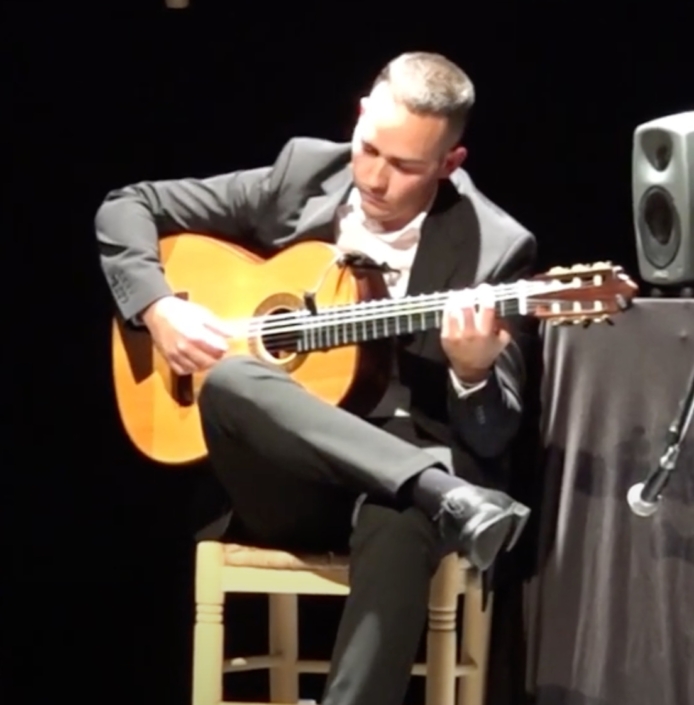
In the fascinating world of flamenco, Lluis Castañ emerges as an inspiring example of vocation and dedication.
With no flamenco background and coming from classical guitar, he found his passion after discovering the collaborations between Paco de Lucía and Camarón. As a student at the Escuela Superior de Música de Cataluña (Esmuc), under the tutelage of Rafael Cañizares, Lluis has achieved in just four years an extraordinary progression that has led him to participate in international projects alongside guitarist Pedro Navarro and to create his own show “Entre Cuerdas y Vías”.
In this interview, Lluis shares his musical journey, his technical challenges and his unique vision on learning and performing flamenco guitar, demonstrating how passion and dedication can open new paths in this art.
Question: How long have you been playing flamenco guitar and what motivated you initially to learn this style?
Lluis: I’ve been studying flamenco guitar for 4 years, although before I had some notions about flamenco and flamenco guitar, but I was studying classical guitar. The first thing that motivated me was when I heard Paco de Lucía with Camarón, which left an impact on me. Then, a flamenco guitarist from Castellón, Pedro Navarro, was my teacher in the classical guitar course and I started to look at some techniques and play concerts with him.
Question: What resources or study materials have been most useful to you in your learning?
Lluis: The exercises for the flamenco technique, because I came from a classical technique and changing it took me a lot of work.
Question: How do you structure your practice routine? How many hours do you dedicate daily or weekly?
Lluis: For my daily routine, I do some technique exercises like picado, arpeggio, strumming or tremolo to warm up, trying to increase my speed every day. Then, I start with the daily homework or composition. It’s usually at least 3 hours a day, and it can reach 7 or 8 hours a day during important concerts.
Question: Do you have any flamenco guitarist that you consider your greatest reference? What do you admire about his style or technique?
Lluis: I have two references, in principle, I have Paco de Lucia as all flamenco guitarists, and then, I really like Antonio Rey. I admire both of them for their technique and dedication to the instrument, together with the great sensitivity they have both in composing and playing.
Question: Among the various flamenco techniques (alzapúa, rasgueo, picado, etc.), which has been the most difficult for you to master and why?
Lluis: For me, the technique that a flamenco guitarist has in his right hand, there is no other guitarist who has it. Of these techniques, the most different for me is the alzapúa, which is not used in classical guitar and I find it difficult to master.
Question: Which flamenco palo do you find most difficult to perform and why, what has been the most challenging piece or technique you have faced so far and how did you overcome it?
Lluis: As a flamenco palo I would say the seguiriya, since it has a different meter and I’m not used to it. As a more challenging piece I could say some soleá por bulería, like Manolo Sanlucar’s “De Capote” or Antonio Rey’s alegrías “Aromas de la Caleta” or “Calle Cañaílla”, as well as Juan Carlos Romero’s seguiriya “La Hora Sin Remedio”.
Question: How has your understanding of flamenco compás evolved since you started?
Lluis: I think it has improved, since I study a lot with compás bases for each of the palos, but there is still a long way to go.
Question: In your experience, what is the most challenging aspect of playing flamenco guitar?
Lluis: For me, the most complicated aspect of flamenco guitar is the fact that it is “improvised” or “momentary” along with singing or dancing. The guitarist is the one who has to maintain both the rhythm and the harmony.
Question: What advice would you give to someone who is just starting to learn flamenco guitar?
Lluis: My advice is not to get discouraged. For someone who comes from outside the flamenco world, it can be very big and it can generate anxiety to try to control everything, but at the beginning you have to go little by little. The career of a flamenco guitarist is a long-distance race, in which every step counts and you have to climb many steps to be able to play well. I hope to be able to climb those steps someday.
Question: How do you balance learning pure technique with expressiveness and “duende” in your playing?
Lluis: It’s true that there is a big difference between an exercise you do to improve your technique and when you play a piece. For me it is important to change the chip when interpreting, to relax the whole body and not to have too much tension, because that is transmitted when playing.
Question: What role do you think flamenco tradition and culture plays in your development as a guitarist?
Lluis: Flamenco has given me many tools to be able to compose my works and flamenco tradition and culture is something I have a lot of respect for and I always try to maintain and continue with it.
Question: In your experience with accompaniment, how do you handle the musical dialogue between guitar, singing and dancing?
Lluis: For me, as I have already mentioned, it is a very complicated aspect, because of the improvised and momentary nature. Having the responsibility of having all the “compás” and harmony depend solely on you, and besides, playing and answering both the cante and the dance is something challenging.
Question: What led you to enter the world of flamenco and how has it transformed your musical perspective?
Lluis: I don’t come from a flamenco family, in fact, there is no musician in my family, but they have always supported me in everything I wanted to do. One day, a friend showed me a live recording of Paco de Lucía and Camarón and, since then, I wanted to learn flamenco guitar. I soaked up Paco de Lucia’s live album from 2010 and it opened up a huge world that I wanted to know. Flamenco has made me understand music in a different way, no longer stuck to the score, as I was used to, and it has taken me to places I could never have imagined, playing concerts all over Europe in big theaters and festivals.
Question: What guitar do you play?
Lluis: For the last 10 years, I have had a guitar from Hermanos Sanchís, Soleá model, but for the last 4 years I have had a wonderful guitar from Vicente Carrillo, which I use to study and play in concerts.
Question: Where do you study flamenco guitar?
Lluis: In 2020, I took the exams to access the master’s degree in flamenco guitar performance at the Esmuc in Barcelona. I managed to get in and I took this master’s degree with Rafael Cañizares as a teacher, along with others like Alfredo Lagos. I liked it so much that I decided to take the undergraduate studies at the same school, where I have been traveling every week from Castellón for 4 years now.
Question: What projects or concerts are you working on?
Lluis: I am part of the project of the guitarist Pedro Navarro, where we play his compositions as a guitar duo. With this project we tour all over Europe, we have played in festivals in Paris, London, Venice, Munich, Czech Republic, Denmark, Croatia or in national festivals like the guitar festival in Granada or the one in Linares, in Andrés Segovia’s house. I am also part of a rumba/pop group, called “Jarana”, which has been very successful in Castellón for many years.
As a composer and solo guitarist, I have just released my show with only my own creations, called “Entre Cuerdas y Vías”, in which, apart from guitar, we have singing, flute and a dance troupe. It has just been released and my wish is to be able to do many concerts with this show. In this show and in my works I try to capture all my experiences and experiences.
Leave a Reply
Want to join the discussion?Feel free to contribute!