
Paco Cepero: Roots and Rhythm in Flamenco Art

A life in flamenco
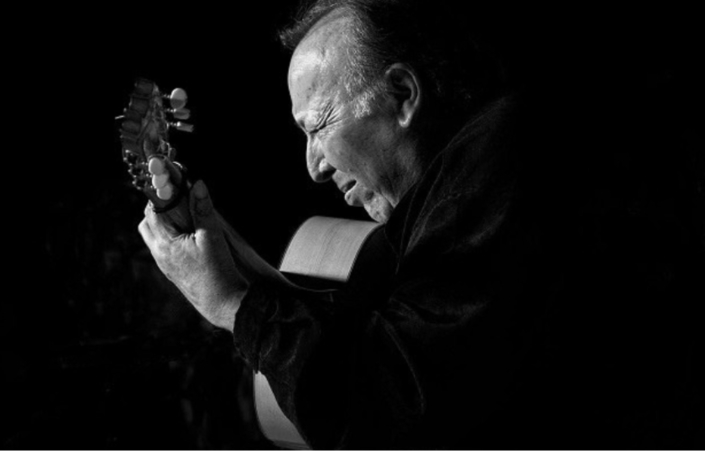
Paco Cepero
When it came to taking stock of his 60-year career, he said that “I wouldn’t take anything away. It has been worth everything to me,” even though the early days were not very pleasant.
“Every year has been good.”
Paco Cepero (Francisco López-Cepero García) was born on March 6, 1942 in the neighborhood of San Miguel, in Jerez de la Frontera. He was not a guitarist who came to flamenco: he was born into it. His family was linked to flamenco singing – he was related to the cantaor José Cepero – and his father’s tabanco was his first conservatory.
In those spaces there was no written method, but there was a hierarchy: the cante was the authority and the guitar its architecture. This conception of guitar playing as support and structure would accompany him all his life. From an early age he was fascinated by the guitarists who passed through the family tabanco, where artists and amateurs gathered. At the age of six or seven he had already awakened his definitive vocation.
His great uncle, a great cantaor of personal fandangos, warned him: “son, don’t dedicate yourself to this as a profession”. But his destiny was sealed.
He trained with the Jerez master Javier Molina, heir to the classical Andalusian school, and with Rafael del Águila -known as Rafael el Gallo-, from whom he learned to “feel the guitar in his stomach”. From this double influence his stamp is born: harmonic clarity, technical cleanliness and an exact placement of the chord. He was not a revolutionary of virtuosity, but a builder of structure, with a brilliant Jerez compás and an ability to solve musical labyrinths without excess or artifice.
He made his professional debut in 1958, when he was only 16 years old, at the Gran Teatro Falla in Cadiz. It was not a youthful anecdote, but the real beginning of a career that has known no interruptions. In those early years he participated in local festivals, charity performances and tours around the province of Cadiz, accompanying artists such as La Paquera de Jerez.
His style, deeply marked by the family tradition and the teaching of his teachers, already showed a pure flamenco, of contained but intense energy, in which the guitar could assume a leading role on stage without ever invading the singing space.
Madrid: consolidation and artistic maturity
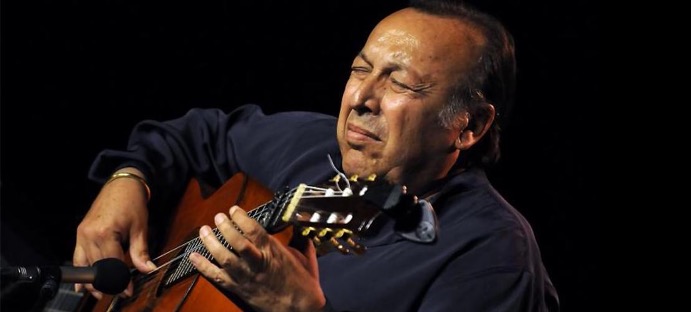
In 1963 he settled permanently in Madrid and joined the cast of the tablao Los Canasteros, owned by Manolo Caracol, one of the nerve centers of flamenco in the capital. There, flamenco singers, dancers and guitarists coincided in the midst of the effervescence of the sixties, at a time when the tablao was a school, a showcase and an artistic battlefield at the same time.
Cepero would remain more than thirty-five years in Madrid, establishing himself as one of the most sought-after accompanists on the flamenco scene. From there he toured Europe, America and Asia on international tours, when flamenco was beginning to establish itself as a global spectacle, alternating performances in tablaos, halls and festivals, and also developing his facet as a concert guitarist from the seventies onwards.
His playing began to be identified by an essential quality: security. He does not lose the meter, he does not invade the cantaor’s space, he does not exaggerate the musical gesture. In Madrid he finished forging an artistic maturity that, without abandoning the Jerez roots, incorporated with naturalness certain Arab and Latin American sonorities in chords and ornaments. As he himself has recognized, “I have studied many years of my life in the tablaos, that’s where”, a phrase that sums up better than any other the true laboratory of his training.
The guitarist of the cante grande
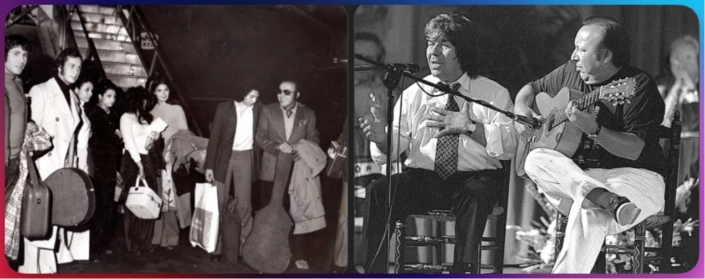
Paco Cepero and Paco de Lucía, on tour in Germany. Rancapino and Paco Cepero.
He accompanied some of the most important flamenco artists of the 20th century: Camarón de la Isla -the first to play professionally-, El Lebrijano, Tío Borrico, Rancapino, Pansequito, Juanito Villar, José el de la Tomasa, Chiquetete, Santiago Donday, La Marelu, El Terremoto, La Perla de Cádiz and Manolo Caracol himself. With El Lebrijano he participated in recitals with Arab music groups, broadening horizons without losing the roots.
With Camarón he left memorable recordings, especially in fandangos and cantes libres where his accompaniment shows an absolute mastery of the air without losing harmonic firmness. His knowledge of cante was deep and practical, tablao and madrugada.
In the bulerías por soleá, his way of resolving por medio is a school. In the natural fandangos, his playing is an example of how to sustain without interfering. In the soleá, the silence appears measured, placed with intention. Cepero does not accompany “por detrás”; he builds the space where the cante breathes, like a tailor who adjusts each measure to the voice in front of him, in the wake of Caracol and Mairena.
In the recording field, he participated in emblematic works such as the debut of El Turronero, Y primero el compás (1970), together with Antonio Arenas, collaborating in their recordings until 1984 and sharing the studio on numerous occasions with Enrique de Melchor. His presence in those records was not ornamental: it was structural.
Prolific composer and producer
Paco Cepero has composed more than 800 works between songs and flamenco pieces. He has been a music producer and arranger in a key stage of the Spanish recording industry. He worked with Rocío Jurado, Julio Iglesias, Manolo Escobar, José José, Lolita, Rosa Morena, Isabel Pantoja, María Jiménez, Los Chichos (full album Porque nos queremos, 1987) and Samuel Serrano (2017, and a bullfighting bulería in 2025 dedicated to bullfighters such as Manzanares, Curro, Morante, de Paula and Borja Jiménez).
In 1982 he composed “Él”, performed by Lucía in Eurovision, representing Spain and coming in 10th place. He has also composed marches for Jerez brotherhoods such as La Yedra Coronada, La Amargura and Señor Flagelado, works for the Royal Andalusian School of Equestrian Art, and a piece for Pope Francis in 2015 during a tribute to the gypsies.
His catalog is not marginal within flamenco: it is transversal. He was a fundamental collaborator in the musical development of Chiquetete (debut in 1977, with songs like “Gitana canastera”) and participated in key albums of the seventies.
Compositions such as the tangos aflamencados for La Marelu or melodies that, as he himself says, “come out unintentionally”, reflect his creative intuition. “The melody comes out unintentionally”, he says, feeling the guitar to “see how my hands are”.
Cepero has always defended the culture of work: “Once you can win the lottery, but so many times and in all styles…”. At one point he left the guitar to focus on more profitable compositions, but he returned with hits like Agua Marina, reaffirming his link with guitar playing.
His solo debut comes with Amuleto (1977). In a context dominated by the technical revolution of the modern guitar, Cepero opted to maintain a personal line based on melody and structural clarity.
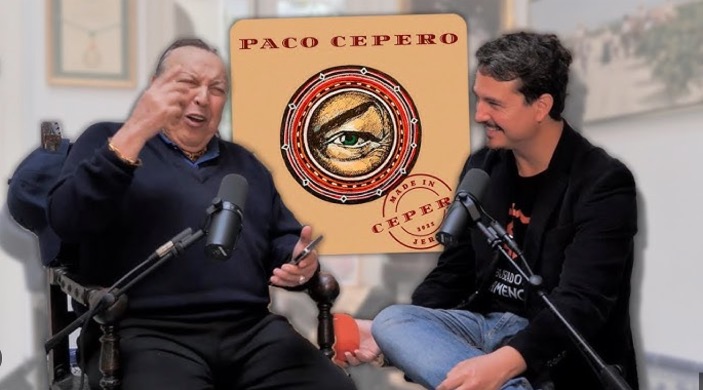
Over the decades he published De pura cepa ( 2000, with “Agua Marina” -flamenca rumba- and “Noche Andalusí”), Corazón y bordón (2004), Abolengo (2007), Suite Gades (2012, a work commemorating the Bicentennial of the Constitution of Cadiz), Sueño Latino (2017, in collaboration with Paco Morillo and with incursions into Latin sonorities), Vivencias (2021, with “Hechizo Andaluz”, “A mi aire” and “Sinfonía Andaluza”) and Made in Cepero (2023, with pieces such as “Estrella de Mar” and “Avellaneda”).
In his most recent works there is no nostalgia: there is synthesis. The guitar sounds more naked, more direct. It is the touch of someone who does not need to demonstrate, but to say.
In addition, he participated in family recordings such as Grabaciones Discos Pizarra – Año 1930 with José Cepero, a nod to his artistic lineage. His albums accumulate millions of listens on digital platforms, confirming the validity of his work.
Interview of the maestro at Expoflamenco
Acknowledgments
He has received, among others, the National Prize of Jerez (1975) and the National Prize of Córdoba (1977), as well as the Castillete de Oro de La Unión and the Yunque de Oro de Ceuta. He was also awarded the Melchor de Marchena Prize for Accompaniment and the Silver Cabal of the Círculo de Bellas Artes (1999).
In 2003 he was awarded the Gold Medal for Merit in the Fine Arts, which was followed by the Gold Plaque of the Province of Cadiz (2006) and his appointment as an Academician of the Royal Academy San Dionisio (2012). He later received the Compás del Cante Award (2014), as well as recognitions such as Camarón de Oro, Leyenda del Flamenco and Gaditano del Año.
In 2017 he was awarded the Medal of Andalusia, along with distinctions such as the Silver Yerbabuena and the Silver Palm in El Rubio. In 2018 he received the Medal of Merit for Work and in 2019 he was named Favorite Son of Jerez.
More recently he has been distinguished with the Bordón Honorífico del Festival del Cante de las Minas (2022), the Premio Andalucía del Flamenco (2022), the Premio Paco Toronjo Leyendas del Flamenco (2025), the Premio Andalucía Excelente en Trayectoria Musical (2025) and the Premio Cultural de la Fundación Cádiz CF (2025).
These recognitions are not protocol: they consolidate his figure as a historical reference of the toque. As he himself has stated, “I have all the recognitions that an artist can have”, highlighting the Medal of Andalusia as a thorn in his side, finally resolved.
Return to Jerez and current life
After more than three decades in Madrid, he returns to his hometown. He does not do it as a retreat, but as a conscious return to the roots. He returns to Jerez with the serenity of someone who has toured international stages and decides to close the circle in the same neighborhood where it all began.
He continues to compose, perform and participate in cultural events, such as his concert at the Teatro de la Zarzuela in 2025, an event that he did not consider as a farewell, but as a natural continuity of his artistic concerns. In 2015 he performed before Pope Francis along with other gypsy artists, in an act loaded with symbolism within his international career.
At eighty-three years of age, he maintains a constant activity, teaching flamenco guitarists and working on new projects, from incursions into Sephardic music to the elaboration of an adagio. He is not a figure frozen in homage, but a practicing musician.
In recent interviews he has reflected frankly on the evolution of the flamenco guitar. He criticizes technique understood as exhibition and warns that speed, when it becomes an end in itself, can empty the guitar playing of its content. “The technique and speed of today I see it for the circus, prefabricated like AI”, he pointed out, although he recognizes that young people have “a great training, like never before”. His warning is not nostalgia, but a call not to lose the flamenco flavor.
Paco Cepero’s place in history
If we situate the flamenco guitar of the 20th century as a map, Paco Cepero occupies a very defined territory. It is not that of radical rupture or expansive virtuosity understood as exhibition. His place is in the structural solidity of classical accompaniment elevated to the category of art.
His legacy is not measured by speed, but by balance. In his playing the compás sustains, the harmonization breathes within the tradition, the chord appears exactly when the cantaor marks it and the sonorous construction avoids excess. There is no superfluous artifice, there is intention.
For the serious student of flamenco guitar, his work constitutes a true school: a lesson in measurement, listening and respect. In times of constant exhibition, this teaching is more necessary than ever.
His influence can be perceived in current generations who, while exploring new languages and scenarios, continue to find in his playing a model of firmness and coherence. Paco Cepero embodies a way of understanding flamenco where roots and intelligence are not opposed, but balanced.
And I am not saying this from a theoretical point of view.
One afternoon more than forty years ago, back in the eighties, I shared the stage with Paco Cepero at the Palacio de los Deportes in Barcelona, in a singing festival. I went with all the energy of youth, wanting to do everything, to play everything… and probably a little accelerated.
At one point during the performance we coincided in the dressing room. It was something quick, without ceremony. He looked at me and said:
“Very good… but you have to play quieter, more seated.”
Nothing more. No speeches or theories.
I went back on stage and kept playing. But eventually I understood what he was telling me. It wasn’t about posture. It was about calm. Of rhythm. Of not running for the sake of showing off. Of letting the singing rule.
That comment, said quietly and without wanting to impress anyone, helped me much more than a lot of applause. Teachers don’t tell you what flatters you; they tell you what makes you grow. And even if it takes a while to catch on, you have to listen to them. They know what they’re talking about.
Thank you, maestro.
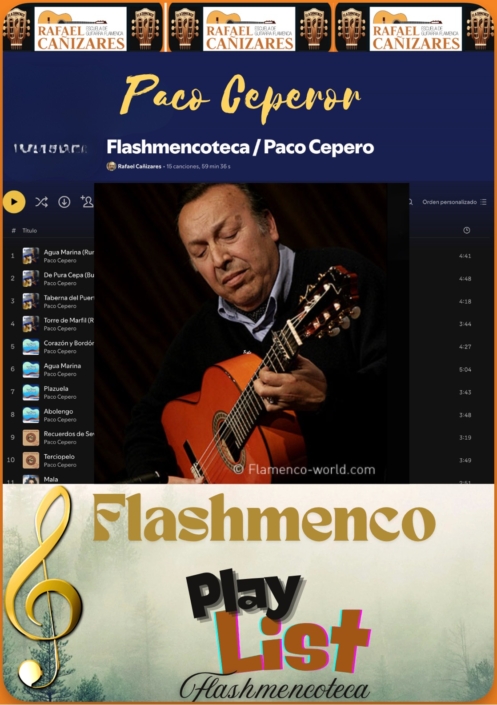
Click on the image to listen to the Flashmencoteca by Paco Cepero
Leave a Reply
Want to join the discussion?Feel free to contribute!