
Mario Escudero – The bridge between tradition and modernity of the flamenco guitar
Introduction
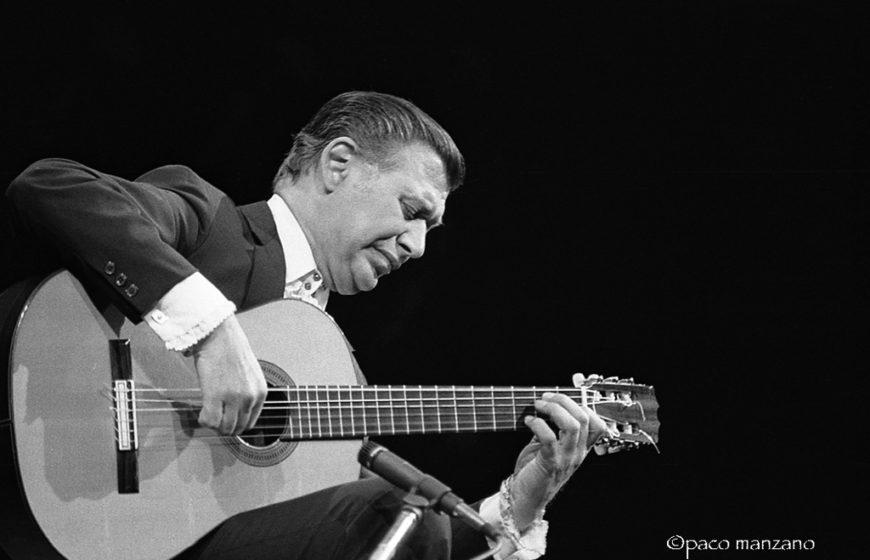
Few names in the history of flamenco guitar have managed to balance the purest tradition with an avant-garde vision as Mario Escudero did. His music was not only a bridge between the generations of Ramón Montoya and Sabicas, and those of Víctor Monge Serranito, Manolo Sanlúcar and Paco de Lucía, but also marked a before and after in the international projection of flamenco guitar. I had the privilege of meeting the master Mario Escudero personally back in 1980, in an experience that remained engraved forever in my memory. We shared an afternoon at his home, playing and talking, surrounded by his warm hospitality. Escudero, always courteous and cordial, was the definition of a true gentleman. That same afternoon, I was also lucky enough to be taken to meet Sabicas, who received us in the hall of his residence, an elegant building that functioned as a hotel. It was a unique encounter with two flamenco legends, framed in a cold winter afternoon in the Big Apple of New York. Moments like these transcend time, leaving an indelible mark. Thank you Maestro This article not only explores his life, work and legacy, but also seeks to convey the humanity and genius of a master whose influence continues to live on in new generations of guitarists.
Chronological Biography of Mario Escudero
Childhood and Early Years (1928-1944)
Mario Escudero Valero, also known as El Niño de Alicante, was born on October 11, 1928 in Alicante, Spain. Son of the gypsy guitarist Jesús Escudero and the cupletista Josefina Valero, he grew up in an artistic environment that deeply marked his life and career. During the Spanish Civil War, the family moved to Biarritz, France, where they formed the Escudero Trio with his aunt Milagros. At the age of 8, Mario made his debut in Bordeaux, presented by the famous promoter Maurice Chevalier. This was the beginning of a promising artistic career, during which Mario performed solo performances in between Trio Escudero’s numbers, earning the public’s recognition.
Training in Madrid and First Artistic Phase (1940-1955)
In the early 1940s, the family returned to Madrid, where Mario began to train in flamenco guitar under the tutelage of Ramón Montoya and Niño Ricardo, two of the great references of the genre. He also studied classical guitar with Daniel Fortea, who taught him the technical fundamentals of this instrument, which would later become part of his own flamenco style. His professional debut came in April 1944, when he was only 15 years old, at the Palau de la Música in Barcelona, as part of Vicente Escudero’s company. Later, he performed at the Teatro Español in Madrid with Ramón Montoya, who praised him as “the best flamenco guitarist of the new generation”. During this period, Mario stood out as an excellent guitarist accompanying singing and dancing, collaborating with figures such as Carmen Amaya, Antonio y Rosario, La Niña de los Peines, Antonio Mairena, Canalejas de Puerto Real and José Greco. His elegant and clean touch, described by Vicente Escudero as “the most elegant I have ever encountered”, consolidated him as one of the most promising artists of his generation.
International Career and Consecration in the United States (1955-1980)
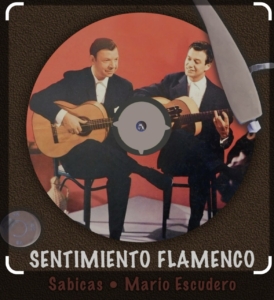
In 1955, Mario made his debut as a soloist at Carnegie Hall in New York, a milestone that marked the beginning of his international career. After this success, he decided to settle in the United States, aware of the interest in solo flamenco guitar in that country, something that did not yet exist in Spain. He founded the Escudero Flamenco Center in Manhattan, where he taught classes and promoted flamenco guitar as a concert art. Mario worked closely with Sabicas, his cousin and mentor, with whom he recorded emblematic albums such as Fantastic Guitars and Romantic Guitars. During this period, he also composed some of his most iconic works, such as Ímpetu, a virtuoso bulería that was transcribed by American musician Joseph Trotter in 1957, making him a pioneer in the written dissemination of flamenco guitar.
During his stay in the United States, Mario had contact with musicians such as Moreno Torroba, who adapted some of his compositions for large orchestra. He also performed Joaquín Rodrigo’s Concierto de Aranjuez with the Lexington Philharmonic Orchestra in 1977 and presented his work Fantasía Flamenca with orchestra.
Innovations and Style
Mario Escudero was an innovator in several technical and stylistic aspects:
- Dispensing with the capo: Freed the flamenco guitar from traditional tonal limitations.
- Crossed posture: He adapted a more ergonomic position, inspired by the classical guitar.
- Use of concert guitars: He preferred Conde Hermanos models, optimized for the stage.
- Complex harmonies: He combined flamenco jondura with modulations and sophisticated harmonic elements.
His style was characterized by an extraordinary technical cleanliness and a dynamism that shone especially in festive styles, such as bulerías and alegrías. Works such as Tonadilla demonstrate his modernity, while in the serious styles, such as soleá and taranta, his playing became more precious and melodic.
Return to Spain and Awards (1980-1990)
Throughout the 80’s, Mario returned to Spain on several occasions, participating in events such as the III Bienal de Sevilla, dedicated to guitar playing, where he surprised many aficionados. He also stood out in the Festival de la Guitarra de Córdoba and in the Gazpacho Andaluz de Morón de la Frontera. In 1987, he received the National Award from the Cátedra de Flamencología de Jerez, a recognition of his exceptional contribution to flamenco guitar. However, his attempts to settle back in Spain in the late 1980s were unsuccessful, and in 1994 he returned permanently to the United States.
Final Years and Legacy (1990-2004)
In 1990, he gave his last great concert at the Istanbul International Music Festival. Affected by diseases such as Alzheimer’s and Parkinson’s, he spent his last years in Miami, Florida, where he died on November 19, 2004.
Mario Escudero left an immense legacy as a performer, composer and teacher. He was a bridge between the generations of Ramón Montoya and Sabicas, and those of Paco de Lucía, Manolo Sanlúcar Víctor Monge. His most famous work, Ímpetu, continues to be an obligatory reference for guitarists all over the world.
Written Contributions and Recordings
Mario was one of the first flamenco guitarists whose works were transcribed to the stave. In addition to his recordings with Sabicas, he left memorable albums such as Mario Escudero plays classical flamenco music (1969), where all the compositions are of his authorship.
His music stands out for its enormous technical cleanliness, dynamism and ability to capture both the tradition and modernity of flamenco. Ímpetu and Para Amina remain reference pieces in the contemporary flamenco repertoire.
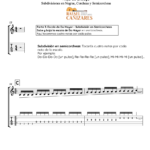
Ímpetu (Bulerías)
Final Reflection
Mario Escudero was much more than a guitarist; he was a visionary who took the flamenco guitar to international stages, transforming it into a concert instrument with global recognition. His legacy lives on as an inspiration for generations of guitarists and flamenco lovers.
My thanks and appreciation to all the people, stories and documents that have shared knowledge about Mario Escudero, making this article possible. Without his legacy and the collaboration of those who keep his memory alive, this work would not have been possible. This article is, in part, a collective tribute to one of the great masters of flamenco guitar.
Rafael Cañizares
Sources and Acknowledgments
This article has been constructed from a wide variety of sources documenting the life and work of Mario Escudero, combining personal testimonies, interviews, critical analysis and historical records. We are especially grateful for access to the following sources:
- Recordings and Transcriptions:
-
- Mario Escudero plays classical flamenco music (1969). Transcriptions made by Joseph Trotter in 1957.
- Works adapted by Federico Moreno Torroba, such as Fantasía Flamenca, based on compositions by Escudero.
- Interviews and Personal Stories:
-
- Interview to Mario Escudero in the program Madrid Flamenco of Onda Madrid (1988), conducted by José Manuel Gamboa and Juan Verdú.
- Anecdotes compiled by Estela Zatania, published in Deflamenco.com (2004).
- Articles and Specialized Publications:
-
- Zatania, Estela. “Mario Escudero: A bridge between generations.” Published in Deflamenco.com, 2004.
- Torres, Irra. “Semblanza a su memoria.” Published in Deflamenco.com, 2021.
- Lobdill, Jerry. “Mario Escudero in Austin: Chronicle of a master.” Texas Flamenco Review, 1979.
- Acknowledgments and Official Records:
-
- National Awards of the Chair of Flamencology of Jerez (1987).
- Documentation on his participation in the III Bienal de Flamenco de Sevilla (1984) and the Festival de la Guitarra de Córdoba.
- International Reviews and Chronicles:
-
- Zern, Brook. “The Elegance of Mario Escudero.” Published in The New York Times, 1985.
- Reviews and programs of his performances at Carnegie Hall and other international venues.
- Written Testimonials and Contributors:
-
- Stories and analysis provided by fans and contributors, including Irra Torres and Brook Zern.
- Acknowledgements to Sevilla Flamenca magazine (n.º 8, 1984) for interviews and additional material.
Books on sheet music with CD
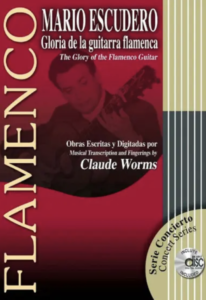
- “Mario Escudero: Gloria de la Guitarra Flamenca”
Book and CD compiling nine of his most outstanding compositions, such as the buleríaÍmpetu. The CD includes a radio interview that offers an intimate vision of his art.
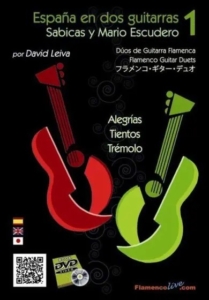
- “Spain in Two Guitars. Sabicas and Mario Escudero by David Leiva”
Series with scores and DVDs that break down the works of the Sabicas-Escudero duo. Designed for guitarists of all levels, it includes performances at various speeds and audio options to facilitate learning.
Leave a Reply
Want to join the discussion?Feel free to contribute!