
Progress Stories – Inspirational Stories from Our Alumni
Claudia Schwarzer: A Journey of Perseverance and Flamenco Passion
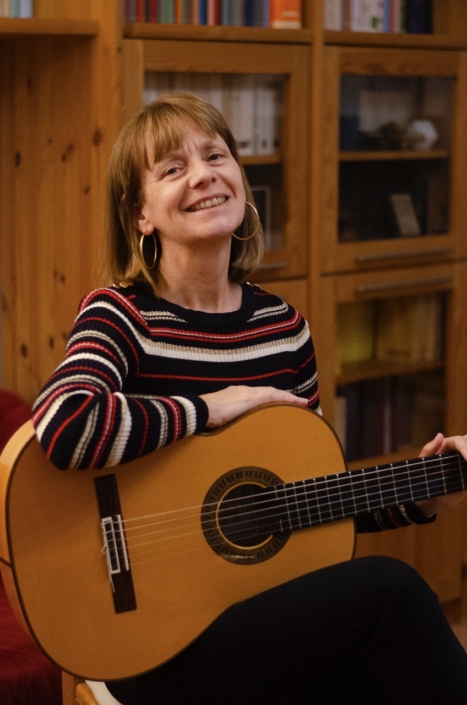
There are stories that show us how passion and determination can overcome any challenge, and Claudia Schwarzer is one of them: a guitarist who has turned every obstacle into a stepping stone to her dream. From the classrooms of the Hannover College of Music to her encounter with the flamenco guitar, her career is a testimony of determination and unwavering love for music. Inspired since childhood by the legendary Paco de Lucia, Claudia dreamed of delving into the art of flamenco, even when circumstances seemed impossible. But her biggest challenge came when focal dystonia threatened to keep her away from music. This condition, which made it difficult for her to perform precise movements with her left hand, could have marked the end of her musical path. However, far from giving up, Claudia decided to reinvent herself. She found new ways to connect with the guitar, confronted the problem with specialized therapy and, little by little, rediscovered her ability to express her art. In this interview, Claudia shares the moments that defined her trajectory, the lessons learned from her challenges and how she lives flamenco as an inexhaustible source of strength and emotion. Her story inspires us to understand that music is not just technique, but an expression of the soul that can transcend even the most difficult physical barriers.
Join us to know the story of Claudia Schwarzer, an example of perseverance, overcoming and unconditional love for the flamenco guitar.
Career and training
Question: What does flamenco guitar represent for you at this moment in your life? Claudia: The flamenco guitar represents an essential part of my identity and a source of constant learning. It is the bridge between my passion for music and my need for personal expression. Despite the challenges, I always find in it an energy that drives me forward. Question: Can you tell us about the moment that awakened your passion for flamenco? What sensations or experiences captivated you for the first time? Claudia: I was already fascinated by the spontaneity of flamenco guitarists and their natural, fluid way of moving when I was studying classical guitar. I was also lucky enough to see Paco de Lucia in concert in Hannover when I was a child, and it made a big impression on me. Since then, I wondered how it would be possible to learn something so incredible.
Another motivating experience was a group of “palmeros” who gave a captivating performance using only the flamenco rhythms of their hands. I thought I wanted to discover the secret of this rhythmic virtuosity as soon as I had the opportunity. However, this desire was difficult to realize in Germany at the time of my studies: traveling to Spain was expensive. That’s why I concentrated on my classical guitar studies at the Hochschule für Musik in Hannover. Question: Tell us about your training: Which teachers or schools were fundamental to your development? What would you learn from each of them? Claudia: My teacher in Hannover, Hans Michael Koch, was instrumental in my training and taught me the potential of numerous guitar composers, especially Spanish. I had studied with Regino Sainz de la Maza, and I realized that Spanish culture is key for the guitar. During my studies, I met Roberto Aussel, whose expressiveness and technical precision attracted me a lot. After my studies in Hannover, I studied with him in Paris and focused on the Latin American repertoire. Years later, I discovered flamenco guitar and Rafael Cañizares. After a lot of research, I sent him an email, and thus began an extraordinary collaboration. Rafael helped me not only with flamenco, but also to overcome a serious problem that was costing me a lot of energy. Question: What criteria did you use to choose your current instrument, what qualities were you looking for in a guitar and how does this influence your playing? Claudia: I chose a Vicente Carrillo (Pasión) guitar with a spruce top because I like its bright and clear sound, as well as being more comfortable to play.
2. Technical and artistic evolution
Question: What moment do you remember as a milestone in your connection with flamenco music? Claudia: One of the most significant moments was when I started playing bulerías. Although at first it seemed unattainable to me, with time I managed to feel its rhythm in a more spontaneous way. That was a deep connection that marked me. Question: How has your perception of rhythm evolved since your beginnings? What strategies have helped you internalize the different rhythms?
Claudia: I have always been fascinated by complex rhythms, and playing with bases has helped me gain confidence little by little. At first it seemed strange to me, but I soon found the joy of practicing with this medium and understanding the rhythms better. Question: Which palo of the flamenco repertoire has demanded the most dedication from you, and which specific aspects were more complex and how did you approach them? Claudia: The bulería is difficult for me because of the fast rhythm and the complex right hand technique. I combine simple falsetas with rhythms and increase the tempo progressively. At the same time, I practice more challenging pieces at a slow tempo. Question: In terms of flamenco techniques, could you describe your learning process with the one you found most difficult to master? Claudia: I find the right-hand strumming in bulería a challenge. During the lessons with Rafael, I insist that he comment on my new rhythms and suggest exercises. I find that I am becoming more and more confident, but I find that regular feedback is essential.
3. Experiences with dystonia
Question: What signs or changes did you notice in your playing that led you to make a diagnosis? Claudia: At first I was worried and thought I had a serious disease, such as a brain tumor, since the symptoms seemed identical. I had lost control of complex movements with my left hand. After some research, I decided to seek treatment at the Institut del Art de Terrassa. Question: How did the diagnosis affect your identity as a musician?
Claudia: I could no longer play even simple pieces and decided to get a degree as a German teacher in Italy. Then I got a place in a high school. Although I gave up guitar for a while, I found in language teaching a satisfying path that allowed me to regain my balance.
4. Support and support system
Question: What role did different people play in your recovery process? Claudia: The physiotherapist Sivia Fàbregas and Dr. Jaume Rosset y Llobet from Terrassa were crucial. Also Rafael, with his intuition to train effective sequences, made a big difference in my progress. Question: What personal discoveries did you make during this process?
Claudia: I understood that I needed balance between my activities and I learned to approach problems with common sense. I rediscovered the pleasure of playing with new approaches and strategies.
5. Artistic vision and projection
Question: How do you manage to combine technical precision and emotional expression in your playing? What elements do you consider fundamental to achieve this balance? Claudia: For me, constant practice of the technical aspects is essential; as soon as I neglect this, I don’t have the necessary confidence in my playing. Question: What are your artistic goals for the next few years?
Claudia: I would like to delve deeper into solo works of some basic palos and focus on accompanying different styles. I want to continue exploring the expressiveness of flamenco. Question: What advice would you give to someone who is just starting out in flamenco? Claudia: To approach it with patience and enjoy the process, because every little advance has its magic.
6. From the Wood to the Soul: The Guitar through the 5 Senses
Heard at 🎧 👂
Question: How do you feel your ear has evolved since you started playing? What sounds do you seek to transmit when you play? Claudia: My ear has been fine-tuning: melodies and rhythms of some palos that at the beginning were puzzling to me, are now more spontaneous. I want to transmit the harmonic tensions of the chords and the rhythmic peculiarities of a melody.
Touch ✋ 🤲
Question: How important is the contact with the guitar for you? How would you describe the relationship between your hands and the strings? Claudia: It’s a wonderful feeling to create sounds of different characteristics with the fingertips on the fretboard; that’s inspiring for me.
View 👀 o 🎨
Question: When you play what images or emotions come to your mind? Do you visualize something specific when playing a flamenco style? Claudia: Each palo has its own expressiveness, and I experience something like sensual expression and description of a feeling when I play it.
Olfato 🌲 o 👃
Question: Is there something special about the smell of a guitar or the atmosphere of a guitar workshop that connects with your memories or inspiration? Claudia: For me, a guitar is an awesome tool that I feel connected to. Every little detail built is made to move and sound when you play it, it’s a nice feeling, just like the smell of its wood!
Taste 🎶 o 😋
Question: How do you describe the flavor of flamenco music in your life? What emotions does it transmit to you when you are in the middle of a performance? Claudia: Flamenco music transmits me a feeling of positive energy, I find that this music has an expressive potential that invites movement.
Leave a Reply
Want to join the discussion?Feel free to contribute!