
Paco de Lucía
Chronology and Legacy of a Flamenco Legend
Introduction
Paco de Lucía, born Francisco Gustavo Sánchez Gómez on December 21, 1947 in Algeciras, Spain, is considered one of the most influential and revolutionary guitarists in the history of flamenco. His life and work not only transformed this musical genre, but also brought him unprecedented international recognition, fusing styles and breaking musical and cultural barriers.
Paco de Lucía – The Flamenco Revolutionary
Early Years and Music Education
From a very young age, Paco de Lucía was immersed in a musical environment. His father, Antonio Sánchez, and his brother Ramón were his first teachers, who instilled in him a strict discipline in the practice of the guitar. At the age of six, Paco was already demonstrating extraordinary talent, dedicating long hours to the instrument, a dedication that would be fundamental to his future.
- In 1958, at the age of 11, Paco won a special prize at the Festival Concurso Internacional de Flamenco de Jerez de la Frontera, marking the beginning of his rise in the world of flamenco.
The Beginnings (1961-1967)
In the early 1960s, Paco’s professional career began to take off:
- In 1961, he formed the duo Los Chiquitos de Algeciras with his brother Pepe, releasing their first album, Los Chiquitos de Algeciras (1963), and performing in flamenco tablaos.
- In 1963, at the age of 16, he joined José Greco’s ballet company, touring the United States. This experience connected him with flamenco greats, such as Sabicas, and broadened his musical horizons.
- In 1964, he recorded Dos guitarras flamencas en estéreo with Ricardo Modrego, followed by 12 éxitos para dos guitarras flamencas (1965) and Canciones de García Lorca para guitarra ( 1965), again with Modrego.
- In 1967, he released his first solo album, La Fabulosa Guitarra de Paco de Lucía, in which he showed his mastery of the traditional Francisco Gustavo Sánchez Gómez tavo Sánche with outstanding technical virtuosity. This year he also recorded Canciones andaluzas para dos guitarras and Dos guitarras flamencas en América Latina with his brother Ramón de Algeciras.
Collaboration with Camarón de la Isla and the New Flamenco (1969-1977)

One of the most decisive moments in Paco de Lucía’s career was his collaboration with Camarón de la Isla, a young cantaor with whom he would form one of the most influential partnerships in the history of flamenco:
- In 1969, they released their first album together, Al Verte Las Flores Lloran. Over the next decade, they recorded more than ten albums, revolutionizing traditional flamenco and creating the basis for New Flamenco, a fusion of contemporary elements with tradition.
- In the same year, Paco also released Fantasía flamenca de Paco de Lucía and 12 hits for two flamenco guitars (with Ramón de Algeciras), along with other collaborations such as Hispanoamérica and Paco de Lucía / Ramón de Algeciras en Hispanoamérica.
- In 1971, he published El mundo del flamenco ( with Pepe de Lucía and Ramón de Algeciras) and Recital de guitarra ( with a collaboration with several renowned guitarists).
- In 1972, he released El duende flamenco with his brother Ramón.
- In 1973, Paco achieved massive success with Entre Dos Aguas, a rumba included in the album Fuente y Caudal, which catapulted him to international fame.
- In 1975, he recorded the iconic Paco de Lucia live from the Teatro Real, followed by his groundbreaking album Almoraima (1976), which integrated Arabic sounds and Latin rhythms, further expanding the horizons of flamenco.
Fusion and International Recognition (1981-2004)
During the 1980s and 1990s, Paco de Lucía consolidated his status as one of the world’s most innovative artists:
- In 1980, he released Yo solo quiero caminar, a key album in his musical evolution. A few years later, in 1984, he presented One Summer Night.
- In 1981, he formed his famous sextet, which included musicians such as Jorge Pardo (flute) and Carles Benavent (bass), pioneers in the fusion of flamenco and jazz. That same year, he recorded Friday Night in San Francisco with John McLaughlin and Al Di Meola, a live album that became a milestone in the fusion of flamenco and jazz.
- In 1987, he released the acclaimed Siroco (with collaborators such as Ramón de Algeciras and Pepe de Lucía). This album was followed by Zyryab in 1990, which featured great artists such as Chick Corea and Manolo Sanlúcar.
- In 1991, he performed Joaquín Rodrigo’s Concierto de Aranjuez, accompanied by the Cadaqués Orchestra, marking a key moment in the integration of the flamenco guitar into the classical repertoire.
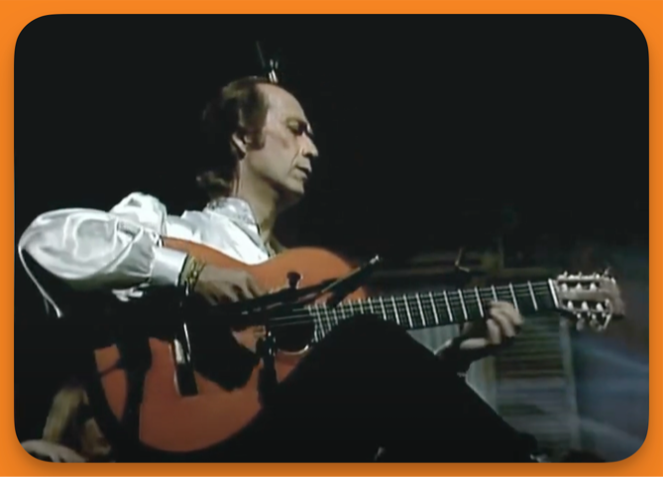
- In 1993, he released Live in America, as part of his sextet, and in 1996 he collaborated again with John McLaughlin and Al Di Meola in a live recording. That same year, he released his compilation album Anthology.
- In 1998, he presented Luzia, a deeply emotional album dedicated to his mother.
- In 2003, he released the complete collection Paco de Lucía Integral and the album Por descubrir.
- In 2004, his album Cositas Buenas, with the collaboration of figures such as Alejandro Sanz, Diego el Cigala, Tomatito and Jerry González, won the Latin Grammy.
Recent Years and Awards (2004-2014)
Paco de Lucía’s last years were a celebration of his legacy:
- In 2004, he released Nueva Antología, a commemorative edition. Then, in 2005, he released Gold, a compilation album of his greatest hits.
- In 2010, he received an honorary doctorate from Berklee College of Music, recognizing his global impact.
- In 2011, he released Paco de Lucia Live with recordings of his 2010 concerts in Spain.
- His last album, Canción Andaluza ( 2014), was a tribute to the Andalusian copla, a genre that influenced him since his childhood.

- After his death in 2014, his legacy continued with the film La búsqueda, directed by his son, Curro Sánchez, and in 2024 Pepito y Paquito, a posthumous album with unreleased recordings from between 1959 and 1960, will be released.
Impact and Contributions to Flamenco
Paco de Lucía revolutionized flamenco in several ways:
- Technical and expressive expansion: He introduced an unprecedented technical precision and expressiveness to the flamenco guitar.
- Fusion with other genres: He was a pioneer in integrating flamenco with jazz, classical music and Latin sounds, which allowed him to reach a global audience.
- New instruments: Introduced instruments such as the Peruvian cajón into flamenco, which has become a central element of the genre.
- Inspiration to generations: His legacy not only influenced flamenco guitarists, but also jazz, classical and world music musicians.
Conclution
Paco de Lucía was not only a virtuoso of the flamenco guitar, but also a visionary who took this genre to new heights. His ability to innovate while maintaining the essence of flamenco made him an immortal figure in the history of music. Throughout his career, which spanned more than five decades, Paco de Lucía redefined the boundaries of flamenco, fusing it with other genres and taking it to unprecedented global audiences. His legacy transcends the musical realm. Paco de Lucía became a cultural ambassador for Spain, bringing the richness and depth of flamenco to international stages and earning the respect of musicians of all genres. His influence extends beyond flamenco guitar, inspiring jazz, classical and world music artists. Paco’s revolutionary technique, speed and precision, combined with a deep musical sensitivity, set new standards for flamenco guitarists. His innovation in composition and arranging expanded the musical vocabulary of flamenco, integrating elements of jazz and classical music without losing the essence and emotion of the genre. In addition, Paco de Lucía played a crucial role in the internationalization of flamenco. His collaborations with world-renowned artists such as John McLaughlin, Al Di Meola and Chick Corea not only broadened his own musical perspective, but also introduced flamenco to audiences who might not otherwise have discovered this rich genre. Paco de Lucia’s impact on Spanish and world culture is immeasurable. His music continues to inspire new generations of musicians, and his legacy lives on in every note played by those who seek to push the boundaries of his art. Paco de Lucia was not only an exceptional musician, but a true artist who changed the course of musical history, leaving an indelible mark on flamenco and music in general. In short, Paco de Lucia was much more than a virtuoso guitarist; he was a musical revolutionary, a bridge between cultures and an artist whose passion and dedication elevated flamenco to new heights. His legacy will live on for generations to come, ensuring that his influence and music will continue to inspire and excite audiences around the world for many years to come.
Exploring the Legacy:
Biographies that Unravel the Genius of Paco de Lucía
Each of the following books offers a unique perspective on the life, work and influence of Paco de Lucía.
- The Paco de Lucía Enigma explores his complex personality,
https://www.lecturalia.com/libro/111435/el-enigma-paco-de-lucia
- The Portuguese woman’s son provides a detailed chronicle of her career.
https://www.planetadelibros.com/libro-paco-de-lucia-el-hijo-de-la-portuguesa/190548
El primer flamenco ilustrado focuses on his impact on flamenco. Paco de Lucía: El primer flamenco ilustrado in AlmuzaraTogether, these books offer a complete vision of the maestro’s legacy, unraveling the different aspects of his musical genius.


Leave a Reply
Want to join the discussion?Feel free to contribute!